Electric Car Loans Vehicle Lease Repayment Calculator
Use this calculator to calculate the monthly lease payments for a motor vehicle. Compare various car leasing interest rates, loan terms and residual/balloon payments.
'Calculator results are estimates only and not quotes. Actual quotes will be provided by licensed brokers after you submit an enquiry.'
Car Lease Details:
Important!
Car Lease Interest Rates differ from lender to lender and will depend on your individual circumstances (credit history, employment status, age, etc.). To find out if you qualify ... and for a free, personalised interest rate and repayment quote,
please CLICK HERE
Car Lease Amortisation Calculator
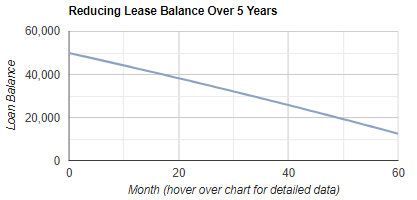
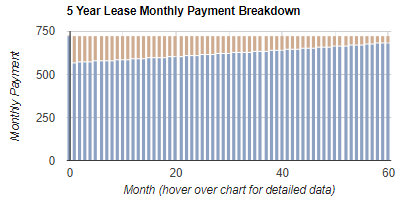
The following amortisation graphs detail month-by-month data on the progress of the proposed loan. The first chart below examines the reducing loan balance over the course of the finance contract term. The second graph illustrates the portion of each monthly repayment allocated to payment of interest vs principal reduction.
How to use our Vehicle Lease Repayment Calculator
Our Vehicle Lease Repayment Calculator helps you estimate monthly lease repayments for a motor vehicle by modelling three key variables: interest rate, lease term, and the residual or balloon amount payable at the end. It’s important because small changes to any of these inputs can materially affect cash flow, total interest over the term, and the end-of-lease obligation, helping you compare scenarios before you speak with a lender or novated leasing provider.
How to complete the form for the best result:
1. Purchase Price
Enter the total amount you want financed for the vehicle. Include relevant upfront costs you intend to roll into the lease (for example, on-road costs or insurance where applicable). Use whole numbers only (no decimals, commas, or dots).
2. Balloon or Residual Value (percent of purchase price)
Select the residual percentage. A higher residual generally reduces the monthly payment but increases the amount left owing at the end, which can increase overall cost across the term. Choose a residual that matches your intended end-of-lease plan (keep, refinance, or sell).
3. Term of Loan (years)
Choose the number of years. Longer terms usually reduce monthly repayments but can increase total interest paid. Select a term that suits how long you expect to keep the vehicle and your budget tolerance.
4. Interest Rate (per annum)
Select an interest rate to simulate. Use a conservative rate when stress-testing affordability, because your actual rate may differ depending on lender policy and your circumstances.
5. Calculate
Click calculate to generate your estimated monthly lease repayment and amortisation visuals.
How to interpret the results:
1. Monthly repayment estimate: Use this as a budgeting guide and compare scenarios by adjusting term, rate, and residual.
2. Amortisation charts: Review how the balance reduces over time and how much of each payment is interest versus principal; this highlights when interest costs are highest and the impact of a larger residual.
ASIC compliance note: This guide is general information only and does not consider your objectives, financial situation or needs. Consider the full lease contract, fees, taxes, insurance, maintenance, and end-of-lease options before deciding, and consider getting personal advice if needed.
Renault’s Scenic E-Tech has joined Australia’s growing electric SUV field, giving family buyers another option in the increasingly busy middle of the EV market. With pricing starting from $55,990 before on-road costs, the Scenic E-Tech is not pitched as a bargain-basement electric car, but it does bring a long-range battery, family-friendly packaging and a well-known European badge into a price band many households are already considering. - read more
Volkswagen Australia’s latest ID.4 update gives electric SUV shoppers another important reference point as the market moves from early-adopter pricing towards more practical family budgets. The arrival of the more affordable ID.4 Pure variant places Volkswagen more directly into the finance conversation for buyers who may have liked the brand’s EV credentials, but previously found the numbers difficult to justify against Korean, Chinese and Tesla alternatives. - read more
Recent reports that BYD is preparing its smallest electric hatch for Australia add another layer to the fast-moving budget EV story. The model, widely known overseas as the Atto 1, is expected to sit beneath BYD’s existing Dolphin hatch if it reaches local showrooms, giving price-sensitive buyers another reason to revisit the numbers on going electric. - read more
Kia’s EV3 is shaping as one of the more important new electric SUVs for Australian households wanting an EV without stepping into luxury pricing. Sitting below larger models such as the EV5 and EV9, the compact SUV brings Kia’s electric vehicle styling, battery technology and family-friendly packaging into a more accessible part of the market. - read more
Eco-friendly cars play a crucial role in reducing carbon footprints, which is vital for combating climate change. These vehicles, particularly electric and hybrid models, are designed to minimize emissions and reliance on fossil fuels. With technological advancements and growing environmental awareness, many Australians are considering these alternatives to traditional petrol and diesel vehicles. - read more
In recent years, there's been a noticeable shift in the way Australians think about transportation. Electric cars are becoming a popular choice for many, driven by a combination of environmental consciousness and technological advancements. With more charging stations popping up across the country and a wider range of cars available, going electric seems like an attractive option. - read more
In recent years, there's been a noticeable surge in the demand for electric cars in Australia. With increasing awareness about environmental issues and more Australians committed to reducing their carbon footprint, the shift towards eco-friendly vehicles is evident. Electric cars offer an effective solution to the challenge of sustainable transportation. - read more
Knowledgebase
Capital Market: A financial market in which long-term debt or equity-backed securities are bought and sold.